
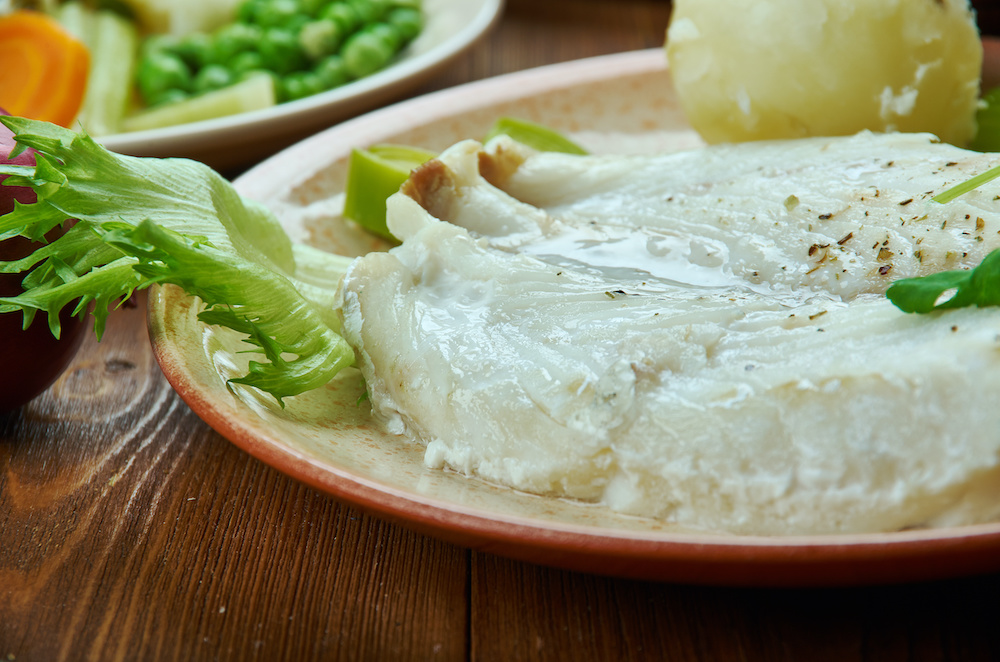
Lutefisk, traditional dish of some Nordic countries, Norwegian cuisine
Every December in far off Norway, families gather around the table for one of the country’s oldest holiday traditions: lutefisk, a gelatinous, centuries-old cod dish still served from the Vikings to the modern era. But what exactly is lutefisk—and how do people react to it when they encounter it for the first time, especially here at OIHS? First: let’s discuss its creation.
Lutefisk begins as cod, dried until it’s as hard as a board. Then, to prepare for cooking, it is soaked first in cold water, then in a lye bath. This lye transforms its structure and gives the dish its notorious, quivering consistency as well as preserving it. After being rinsed to remove the lye, it can be baked or steamed and served with simple accoutrements such as potatoes, peas, butter, or bacon.
To outsiders, this could sound closer to alchemy than cooking. Yet for centuries, it was a solution to the harsh northern winters and long dark seasons with limited fresh food. Over time, the intensive preparation of lutefisk became a Christmas custom, no longer something served for necessity or love-of-taste, but because it connected them to their sea-fairing Viking past. Even here in America, many descendants of Norwegian immigrants will enjoy it as a remembrance of the “old world.” In this way, lutefisk has become less about the fish or taste and more about what surrounds it. It is food meant to be eaten with family, slowly, talked over, and remembered, even if not always fondly.
One of our own ‘Vikings’ who encountered it abroad was Maurice Austin, who spent several months in Norway decades ago. During his time there, his hosts insisted he try lutefisk at least once. While the flavor was manageable when paired with sauce, the texture stood out most. He described it memorably as “uneven, like fish jello, or fish tapioca.” The key is its accompaniments that made a difference, as he said the dish “probably would have been disgusting except for the bacon béchamel.”
As with many traditional foods, the experience was shaped by context. If served today by Chef Zach, I would assume many students of the modern palate would not enjoy lutefisk, but that is not it’s main draw. Its change from survival to a Christmas tradition is what pulls so many Norwegians (and Norwegian-Americans) to this dish. It is not about taste alone, but about history.