
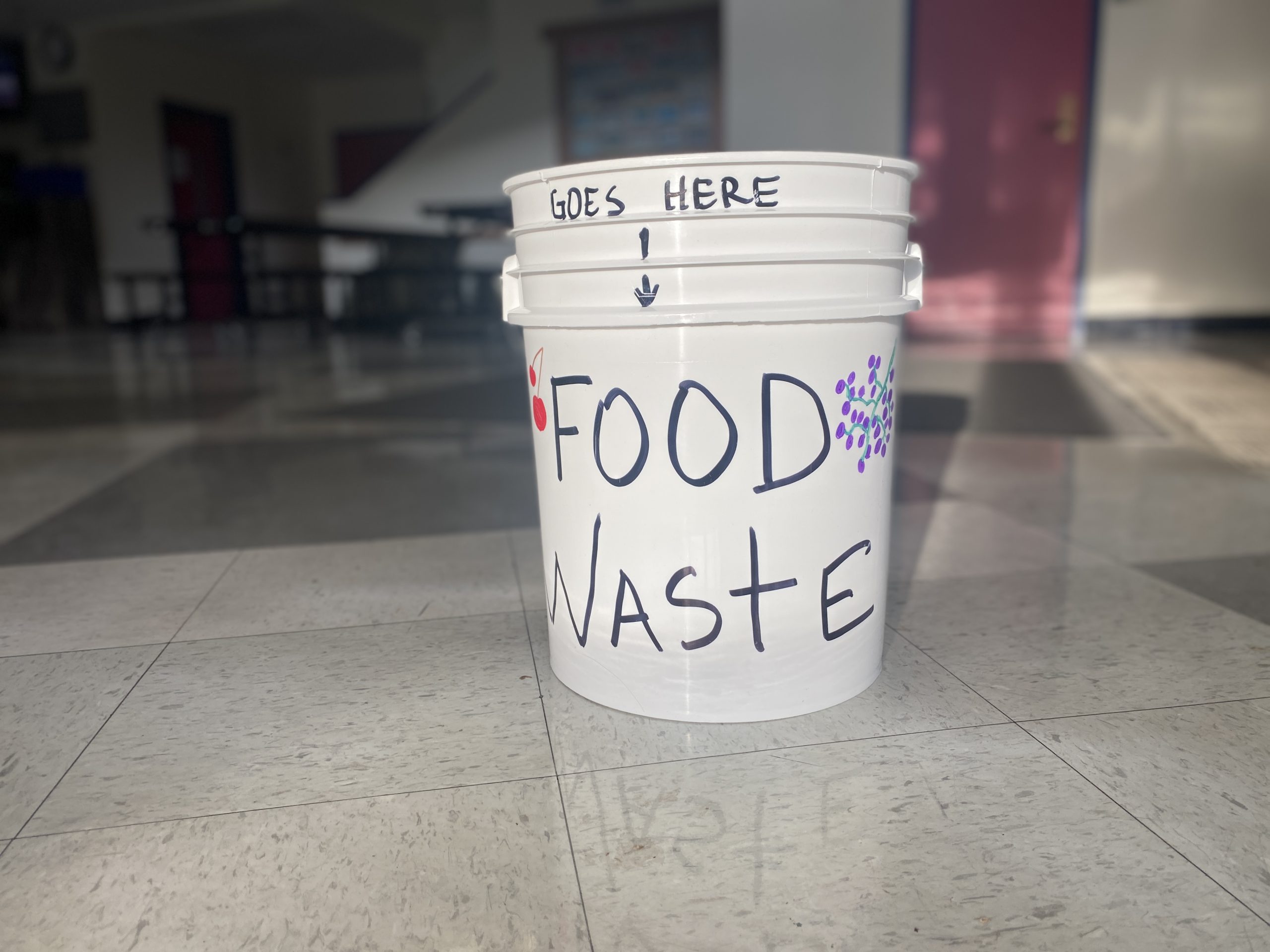
Buckets used to collect food waste during lunch
What happens when you throw your excess food away? It goes to the dump. What happens when wasted food goes to the dump? It rots and produces greenhouse gases. Annually, about one billion tons of food is wasted every year. Which contributes to about 10% of all greenhouse emissions. Schools produce roughly 530,000 tons, which is usually around 39 pounds per student. This waste harms the earth and costs schools approximately 1.7 billion dollars annually. It should be stated that within our school these numbers are all drastically reduced due to our small size, but they are an issue nonetheless. An issue that our own Environmental Club is trying to solve.
For those that do not know Environmental Club meets every Monday and as of October 27th has undergone a Food Waste Diversion Project. Food Waste Diversion is the practice of collecting food waste instead of simply trashing it. A practice that, if done properly, completely negates the issues attributed to food waste. Nearly every day at lunch a member of Environmental Club places and watches over at least one bucket labelled food waste in the commons. All students are encouraged to place their excess food into the bucket(s). At the end of lunch any buckets are taken away to be composted or used for animal feed. Effectively removing the waste entirely.
This project creates useful resources, reduces the school’s greenhouse gas emissions, and saves money. On top of all this it is a community service opportunity available for all students. You do not need to be a member of the Environmental Club to participate and every lunch spent on the project equals one hour of community service. It is beneficial for everyone. Visit room 515, otherwise known as Elizabeth Alperin’s room, on Monday’s or contact sdillard@stu.oisd.org to sign up or if you have any questions. However there is a problem, our school is unique in such a way that for the most part we eat all our food. The project, while productive, has not produced as much waste as was theorized. So any and all suggestions for alternative projects are welcome. Either way the Environmental Club will continue their Food Waste Diversion Project and it remains a volunteering opportunity.